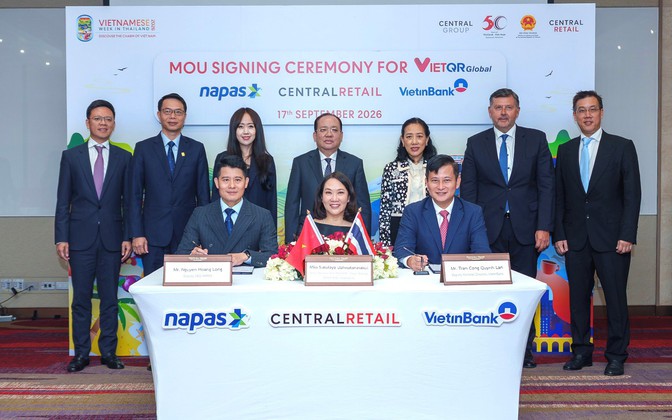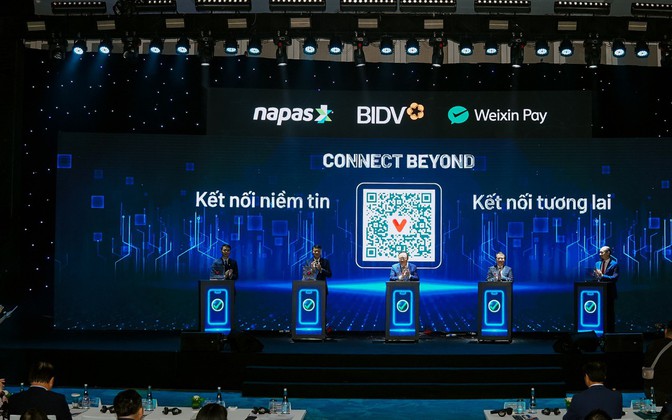


The seminar aimed to promote the expansion of cross-border QR payment services and position VietQRGlobal as an extended enabler of trade, tourism, and retail activities, thereby contributing to broader economic growth. The event also served as a platform for policymakers, industry stakeholders, and businesses to discuss opportunities and solutions for accelerating the adoption of cross-border QR payments. Mr. Pham Tien Dung, Deputy Governor of the State Bank of Vietnam, attended the seminar and delivered keynote remarks.
Also attending the seminar were representatives from the Payment Department of the State Bank of Vietnam; the Vietnam National Authority of Tourism under the Ministry of Culture, Sports and Tourism; the Agency for Domestic Market Surveillance and Development under the Ministry of Industry and Trade; BIDV, Vietcombank, VietinBank, Agribank, KiotViet, the National Cybersecurity Association, as well as international payment and technology organizations, including Tencent's Tenpay (China) and Liquid Group (Singapore).
Representing NAPAS at the event were Mr. Nguyen Quang Hung, Chairman of the Board of Directors; Mr. Nguyen Quang Minh, Chief Executive Officer; Mr. Nguyen Dang Hung, Deputy Chief Executive Officer; and Mr. Nguyen Thanh Tung, Deputy Chief Executive Officer.
https://www.youtube.com/live/_GE57NDcUIg?si=8WQmfUdZ-bVQuzeT
The seminar took place as the banking sector continues to accelerate digital transformation, expand cashless payment adoption, and strengthen payment infrastructure connectivity with international markets.
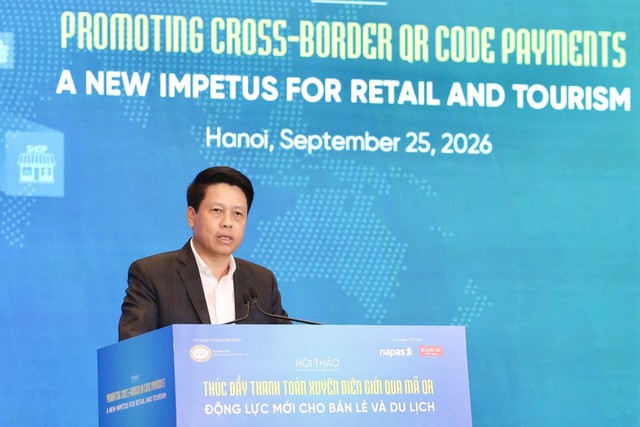
Mr. Pham Tien Dung, Deputy Governor of the State Bank of Vietnam, speaks at the seminar.
In terms of regulatory development and policy direction, the State Bank of Vietnam (SBV) has proactively researched and advised competent authorities on the issuance of, while also promulgating within its authority, numerous legal and regulatory documents to promote the application of science and technology, digital transformation, and cashless payments. In parallel, the SBV has issued various guiding circulars and regulatory documents aimed at ensuring security and safety in banking operations, addressing legal bottlenecks, and enabling the broader adoption of emerging technologies, including authentication via VNeID and the standardization of information system security.
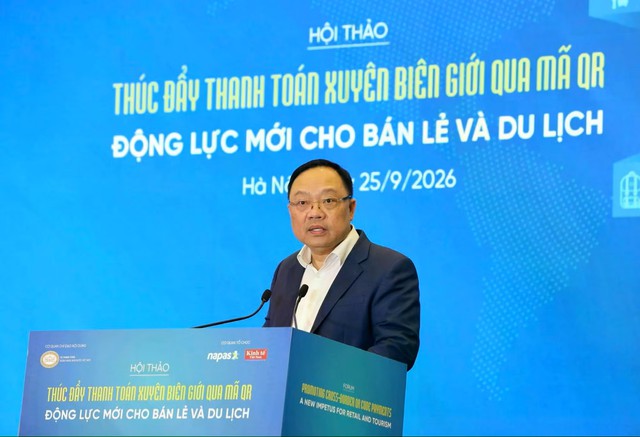
Mr. Pham Anh Tuan, Director General of the Payment Department of the State Bank of Vietnam, speaks at the event.
The infrastructure supporting cashless payments and the banking sector's digital transformation has continued to receive significant investment, upgrades, and development. Vietnam's Interbank Electronic Payment System (IBPS) operates smoothly, securely, and efficiently. Financial switching and electronic clearing systems have further expanded the integration of products, services, and platforms with other sectors, enabling the delivery of public services through the National Public Service Portal, particularly in healthcare, education, and transportation.
ATM and POS networks, as well as merchant acceptance networks for digital payments through POS terminals and QR codes, now extend to nearly all localities nationwide. The State Bank of Vietnam (SBV) has implemented bilateral retail payment connectivity via QR codes between Vietnam and several countries, including Thailand, Laos, Cambodia, China, South Korea, and Singapore, while similar cooperation initiatives with additional markets are currently under development. Credit institutions have also made substantial investments in digital infrastructure and emerging technologies, prioritizing resources for research and development, cybersecurity, and the cultivation of a skilled digital workforce.
The SBV continuously and proactively monitors and directs payment service providers and intermediary payment service providers to strengthen security and safety measures in payment activities. To support this effort, the SBV has launched the SIMO system, an information platform designed to assist in risk management, monitoring, and fraud prevention for customers. Since its deployment and as of August 26, 2026, reports from participating institutions show that more than 5.1 million customer alerts had been issued through the SIMO system. Of those, nearly 1.7 million customers suspended or canceled transactions after receiving alerts, involving transactions worth more than VND 5.7 trillion. These outcomes have made a significant contribution to preventing fraud and scams across digital payment channels.
The banking sector's digital products and services ecosystem has become increasingly interconnected and seamlessly integrated with other industries, enabling the delivery of customer-friendly and highly convenient banking services that meet diverse consumer needs. By the end of 2025, nearly 89% of Vietnamese citizens aged 15 and above had a transaction account with a bank or another licensed institution. The total value of cashless payment transactions exceeded 28 times Vietnam's GDP. During the 2021-2025 period, the annual average growth rates of cashless payment transactions reached 58.86% in volume and 24.36% in value. Many credit institutions reported that more than 95% of their transactions were conducted through digital channels.
According to the SBV, cashless payment activity continued to grow strongly during the first eight months of 2026 compared with the same period in 2025. The number of cashless payment transactions increased by 34.56%, while transaction value rose by 13.26%. Transactions conducted via internet channels grew by 46.57% in volume and 21.77% in value, while mobile payment transactions increased by 35.33% in volume and 2.39% in value. Notably, QR code payments reached 311 million transactions, with a total value of VND 274.2 trillion, representing year-on-year growth of 6.66% in volume and 25.85% in value.
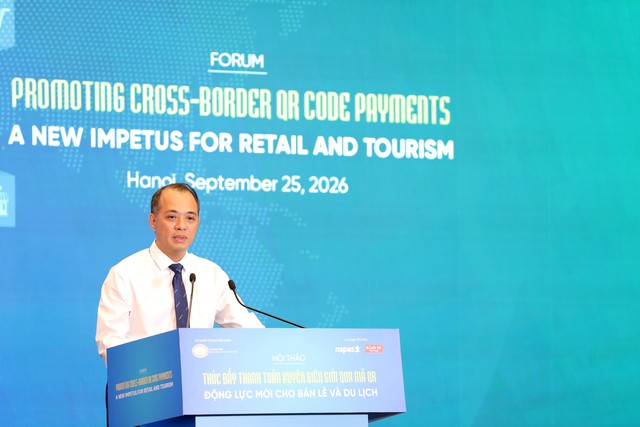
Mr. Nguyen Dang Hung, Deputy CEO of NAPAS, speaks at the event.
According to NAPAS data, VietQRGlobal has been experiencing strong growth across connected markets. During the first eight months of 2026, the number of transactions made by visitors from Thailand, Laos, and Cambodia in Vietnam increased eightfold, while transaction value grew sixfold compared with the same period in 2025. In the opposite direction, transactions conducted by Vietnamese users in these three markets rose fivefold in volume and fourfold in value year-on-year.
China became the next market connected following the expansion across Southeast Asia. NAPAS officially launched the service through its connection with UPI in December 2025, followed by Alipay in April 2026 and Weixin Pay in August 2026, with all connections recording encouraging growth. Just four months after the service expansion, by August 2026, the number of transactions made by Chinese visitors using Chinese payment applications to scan VietQRGlobal codes in Vietnam had tripled, while transaction value increased fourfold compared with April 2026. With the completion of connectivity to major Chinese payment platforms, cross-border QR payment transactions between Vietnam and China are expected to continue growing strongly in the coming period.
In addition, NAPAS has completed the implementation of two-way cross-border QR payment connectivity with Singapore, enabling both Singaporean customers to make QR payments in Vietnam and Vietnamese customers to make QR payments in Singapore. For the South Korean market, the service allowing South Korean customers to make payments in Vietnam has been completed, with plans underway to expand the reverse payment corridor. To date, NAPAS has successfully established cross-border QR payment connectivity with six countries across Southeast Asia and Asia and will continue expanding the service to additional markets in the future.
For users, cross-border QR payments provide a fast, secure, and seamless payment experience, similar to making transactions in their home country. Notably, transactions are processed directly between the two local currencies through the settlement infrastructure of participating entities, reducing costs associated with foreign exchange conversion and delivering tangible exchange-rate benefits to users.
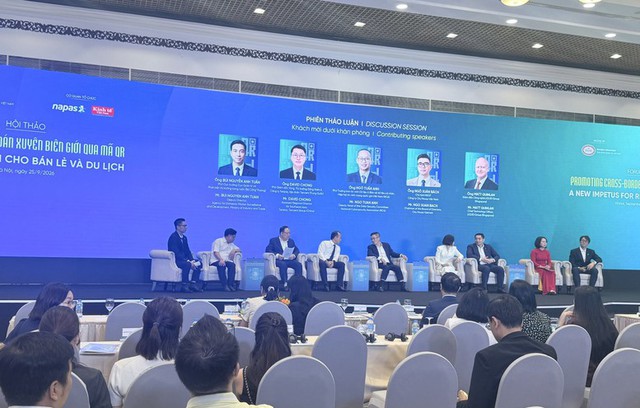
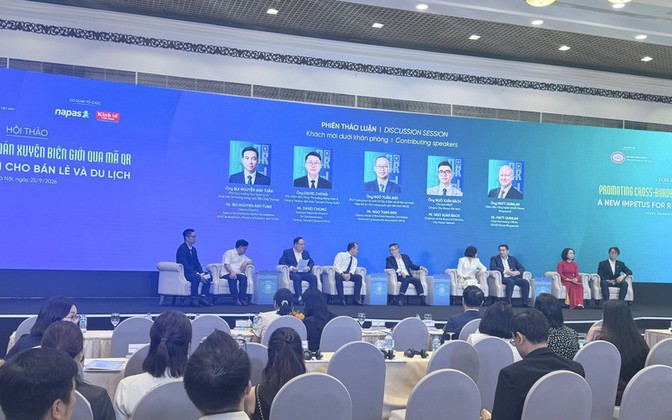
Speakers and industry representatives take part in a panel discussion during the seminar.
VietQRGlobal not only enhances convenience for users but also delivers direct benefits to merchants. When international visitors can use the payment applications they are already familiar with in their home countries to scan QR codes, barriers in the payment experience are significantly reduced, shortening the path from purchase intent to spending decisions. VietQRGlobal also enables restaurants, hotels, household businesses, and small retailers to better serve international tourists without the need for costly card acceptance infrastructure investments that were previously required.
The merchant discount rate for payments made through VietQRGlobal is expected to be around 1.5% of the transaction value, compared to 2.4%–3.0% for international cards issued outside Vietnam. This means that the cost of accepting payments through VietQRGlobal can be approximately 37.5% to 50% lower than that of international card payments.
Speaking at the seminar, Mr. Pham Anh Tuan, Director General of the Payment Department of the State Bank of Vietnam, emphasized:
"Cross-border QR payments are not merely a payment technology solution; they are also an integral component of the digital economy infrastructure and a practical tool that directly supports trade, tourism, and consumption. A tourist can use a familiar application to make payments in Vietnam; a Vietnamese traveler can pay conveniently abroad; and a small business can accept payments from international customers without investing in complex infrastructure. These seemingly small conveniences, when multiplied at scale, can create meaningful economic connections."
According to Mr. Pham Anh Tuan, the objective in the coming years is not only to expand the cross-border payment network but, more importantly, to increase usage, ensure security, improve efficiency, and generate greater value for the economy.
Against this backdrop, the seminar focused on several key issues, including: (1) expanding the VietQRGlobal infrastructure; (2) optimizing payment experiences for Vietnamese travelers abroad and international visitors to Vietnam; (3) broadening the VietQRGlobal merchant acceptance network across shopping malls, tourist destinations, restaurants, hotels, retail outlets, and household businesses; (4) developing support policies for merchants and payment acceptance points; and (5) strengthening security and data protection measures amid the growing threat of cyber-enabled crime.